


Included Highlights
- The Great Rift Valley
- Lake Nakuru NP, Open Vehicle Game Drive with Resident Guide* Maasai Mara Excursion with small vehicle*
- Maasai Village Walk with Resident Guide
- Serengeti & Ngorongoro Crater Excursion in Purpose Built Vehicles, Game Drives with Resident Guide* Zanzibar, Return Ferry & Accommodation
*Highlights are included in the Adventure Pass
Intended Itinerary
It is our intention to adhere to the route described below but a certain amount of flexibility is built into the tour and on occasion it may be necessary or desirable to make alterations to the published itinerary. Please therefore treat the following as a guide only. This is a participation tour. Our accommodated tour option travels together with the camping counterpart.
The description below follows the itinerary with the mandatory Adventure Pass for the tour.
Duration: 28 Days
Countries visited: Kenya, Uganda, and Tanzania
Day 1: Nairobi – Lake Nakuru National Park
Distance traveled: +/- 190 Km Approx. driving time: 4 Hours
Kenya is East Africa’s most popular safari destination and has a long tradition of tourism and of welcoming visitors. Nairobi, the Kenyan capital, has seen rapid growth in recent years but still has a comparatively small city center, interesting city markets, numerous craft shops, book shops and plenty of cafes and restaurants. We recommend you arrive at least one day before the tour departure in order to relax, check out the city and overcome any jet lag.
We depart Nairobi early and descend into the ‘Great Rift Valley’, an enormous cleft in the Earth’s surface stretching from the Red Sea to Madagascar but with particularly marked escarpments here in Kenya. We stop at a lookout point to take in the magnificent views. Our overnight stop is Lake Nakuru National Park, a relatively small park (by African standards) however prolific in wildlife, situated on the Great Rift Valley floor. The shallow soda lake attracts a huge variety of birdlife – especially flamingos, which may gather in such numbers that (when viewed from above) they form a strikingly pink ‘fringe’ around the lakeshore. However, Lake Nakuru is not simply a bird sanctuary, it is also home to buffalo, lion, rhino (black and white), leopard, warthog, baboon, antelope, and a variety of smaller animals. A delightful introduction to East Africa’s wildlife diversity that we search for in an afternoon game drive making use of local guides and smaller safari vehicles for a more intimate experience.
Accommodation: Punda Milias Camp (or similar) – Twin share accommodation with en-suite facilities
Meals included: Lunch, Dinner
WIFI: No
Optional Activities: Nil
Day 2: Lake Nakuru – Eldoret
Distance traveled: +/- 150 Km Approx. driving time: 3.5 Hours
From Nakuru we continue northwest and climb in altitude towards the town of Eldoret en-route to the Ugandan frontier. We cross from the Southern Hemisphere to the Northern Hemisphere today over the Equator, enjoying some time here learning a little about its significance and taking photos before moving onwards to Eldoret. The name ‘Eldoret’ is based on the Maasai word ‘Eldore’ meaning stony river, due to the stony bed of the nearby Sosiani River. The town is the 5th largest in Kenya and is the fastest growing with a population of approx. 194,000. We camp outside of town in a unique campsite created on hilly forest tribal land, once home to members of the ancient Sirikwa tribe. Preserved on the site are excavations with stone sides, commonly called Sirikwa holes, which are believed to have been roofed and occupied by the inhabitants of a bygone age.
Accommodation: Naiberi Overland Camp (or similar) – Twin share accommodation with en-suite facilities
Meals included: Breakfast, Lunch, Dinner
WIFI: No
Optional Activities: Nil
Day 3: Eldoret – Kampala
Distance traveled: +/- 400 Km Approx. driving time: 7.5 Hours
We crossed into Uganda, Winston Churchill’s ‘Pearl of Africa’, a country with beautiful natural scenery and a rich mosaic of tribes and cultures – and friendly people. Our first night we camped at the capital Kampala, an attractive hilly city, bustling with roadside traders, markets and busy matatu (minibus taxi) stands.
Please note that some group members may be starting their tour in Kampala
Accommodation: Red Chilli Camp (or similar) – Twin share accommodation with shared facilities
Meals included: Breakfast, Lunch, Dinner
WIFI: Yes
Optional Activities: Nil
Day 4: Kampala – Queen Elizabeth National Park
Distance traveled +/- 240 Km
Approx. Driving time: 5 hours From Kampala, we travel west towards Queen Elizabeth National Park, crossing the Equator again, through fertile green terraced hillsides, lush banana plantations, steep mountains and tangled forests. From the Acacia vehicle we should see herds of Ankole cattle with their incredible long curving horns roaming the roads and paddocks. We camp a short distance from the Queen Elizabeth National Park. Here you will have the opportunity to relax and unwind, take a walk in the surrounding areas and mingle with the local community.
Accommodation: Simba Camp (or similar) – Twin share accommodation with en-suite facilities
Meals included: Breakfast, Lunch, Dinner
WIFI: Yes
Optional Activities: Nil
Day 5: Queen Elizabeth National Park area
This morning we entered Queen Elizabeth National Park and took in the magnificent views of the mountains that separate Uganda from central Africa as well as Lake Edwards and Lake George. Queen Elizabeth National park has over 500 species of bird and 100 species of mammals, making it one of the most biodiverse national parks in the world. If we are lucky, we may get to spot some of these animals en-route to Kyambura Gorge for the trek to see the chimpanzees. Unlike their larger cousins, the mountain gorilla, chimps live mostly in the trees and so our viewing consists mainly of peering high into the forest canopy. Predictably, the experience of seeing man’s closest relative in the wild is a memorable one.
Chimpanzee Trek permits are issued by the wildlife authority in groups of up to 8 people at a time, per group. Depending on our group size, this means that we may trek on the afternoon of day 4, morning of day 5 and afternoon of day 5 or morning of day 6.
Accommodation: Simba Camp (or similar) – Twin share accommodation with en-suite facilities
Meals included: Breakfast, Lunch, Dinner
WIFI: Yes
Optional Activities: Nil
Day 6: Queen Elizabeth National Park – Lake Bunyonyi
Distance traveled +/- 240 Km Approx. driving time: 5 Hours
We leave the picturesque hills of the national park and make our way to the lush and stunning Lake Bunyonyi (‘Place of many little birds’). This lake is 27 km long, 7 km wide and at an elevation of 1950 meters above sea level, it is surrounded by undulating hills between 2200m to 2478m high. With a depth of nearly 900m in parts, this lake is the second deepest lake in Africa (the deepest being Lake Tanganyika in Tanzania). With twenty-nine islands that can be visited by local boats, the lake is a great place to unwind, relax and explore on the days that we don’t trek to see the mountain gorillas.
Over the next two days the group will be split, with one group trekking to the mountain gorillas while the others stay at Lake Bunyonyi to enjoy the many activities on offer.
Lake Bunyonyi
There are many activities to do here such as hiring canoes to visit some of the lake’s islands, visiting local tribes and villages, visiting the local orphanage, as well as bird watching and nature walks. Alternatively, just relax around camp, catch up on your travel diary or postcards to home, or sort through your photos of your trip so far.
Mountain Gorilla Trekking
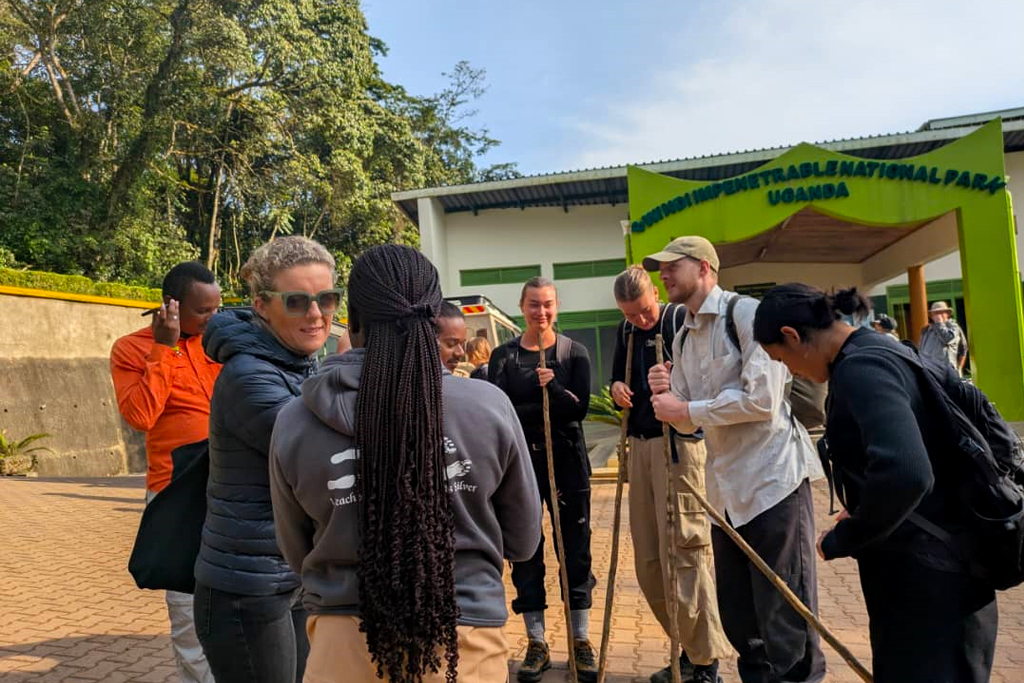
This region of Africa is home to the world’s remaining 700 free-roaming mountain gorillas, many of which inhabit the Bwindi Impenetrable National Park. [we may travel into neighboring Rwanda to trek for the gorillas if need be]
On the day of your trek, we gather in the early morning to meet our local guide and tracker. Walking in small groups, we trek into the thick rainforest. The trek can be demanding at times – with uneven terrain and hilly rainforest, but the privilege of spending time with a family of these gentle primates makes the effort well worthwhile. To many people the day’s trek and time with the gorillas remains their most exciting wildlife encounter in Africa.
The usual procedure, once we have located the gorilla ‘family’, is to squat or sit down and simply observe them for around an hour – the time set by the Uganda Wildlife Authority (the national body charged with controlling and maintaining the gorillas in Uganda). Gorillas are sociable creatures, living in groups between 12 and 20 individuals, usually led by an alpha male (the ‘silverback’ – so called because of the silver hair on his back which grows once the male gorillas reach maturity). Most people find that the gorillas are remarkably human-like at close quarters – particularly in the social interaction between family members and in ‘play’ activity in which the young engage. Photography is permitted (although not with a flash and there are restrictions for those who wish to use a video camera.)
Your permit allows you one trek and gorilla viewing (time limited to one hour). However, because the authorities maintain strict limits on the number of visitors allowed to view the gorillas each day, we may spend several days in the area while all passengers in our group complete the trek and viewing.
NB: Depending on the availability of the gorilla permits the tour itinerary may vary in day to day running order which is based on the brochure itinerary. From time to time, we may have to trek on different days. If at any chance our Gorilla trek should be in another neighboring country, e.gRwanda (instead of Uganda) this may entail extra visa fees although we shall endeavor to advise you before departure of any significant changes to the tour itinerary. Please take the above itinerary as a guideline only. This applies to day 6 – 8 of this tour. Accommodation: Lake Bunyonyi Overland Stop / Gorilla Trek area (or similar) – Twin share accommodation with en-suite facilities Meals included: Breakfast, Lunch, Dinner
WIFI: Yes
Day 7: Lake Bunyonyi Rest Days or Gorilla Trek Day
If not trekking, today is free to explore the surrounding area, discover the Islands by boat on Lake Bunyonyi or relax back at camp catching up on some well-deserved rest and relaxation. Accommodation: Lake Bunyonyi Overland Stop / Gorilla Trek area (or similar) – Twin share accommodation with en-suite facilities Meals included: Breakfast, Lunch, Dinner
WIFI: Yes
Optional Activities:
- Island boat trips US$25 – US$80
- Village Walk US$10
- Traditional Dance US$100
- Bird Watching US$15
- Canoe Hire US$10
Day 8: Lake Bunyonyi Rest Days or Gorilla Trek Day
Today is a trek day or a day at leisure to enjoy the many optional activities in Lake Bunyonyi. Whether relaxing on the shores of this deep Crater Lake with a good book or heading out to the village and orphanage to gain an insight into the everyday life of Ugandans in this area – you’ll no doubt wish you could stay in this beautiful part of Africa for longer.
Accommodation: Lake Bunyonyi Overland Stop / Gorilla Trek area (or similar) – Twin share accommodation with en-suite facilities
Meals included: Breakfast, Lunch, Dinner
WIFI: Yes
Optional Activities: See day 7
Day 9: Lake Bunyonyi – Kampala
Distance traveled +/- 550 Km Approx. driving time: 10 Hours
From Lake Bunyonyi we make our way back across the Equator (stopping for a photo if we have not done so previously) through lush pasture lands and the northern reaches of Lake Victoria (Africa’s largest lake) to Kampala where we will stay overnight. Kampala is a hotspot for great food and entertainment. If time allows, go out to enjoy the nightlife, try the local cuisines and enjoy the hospitality and friendliness of the local Ugandans. Please note that some group members may be ending their tour in Kampala.
Accommodation: Red Chilli Camp (or similar) – Twin share accommodation with shared facilities
Meals included: Breakfast, Lunch, Dinner
WIFI: Yes
Optional Activities: Nil
Day 10: Kampala – Jinja
Distance traveled +/- 80 Km Approx. driving time: 1.5 Hours
Leaving Kampala, we drive the short distance to the town of Jinja on the banks of Lake Victoria and the Nile. It was in 1862 that the British explorer John Hanning Speke recognised Lake Victoria as the ‘source of the Nile’ settling a long running dispute about Africa’s (and the world’s) longest river. From his modest monument on the banks, the Nile begins its 4132-mile course through Uganda, Sudan and eventually Egypt to the Mediterranean Sea.
Our camp is situated on the grassy banks overlooking the Nile River. It is here that we usually have the option to try river rafting – an exciting day out for those enjoying the thrill of ‘white-water’. There is also the opportunity to make some difference to local children at a local school project: ‘Soft Power’ is a locally run volunteer programme aimed at building and improving schools in the Jinja area to which your contribution of a few hours of painting or plastering is always most welcome. Other activities at Jinja include mountain biking, quad biking, village walks and even bungee jumping!
Accommodation: Nile River Explorers (or similar) – Twin share accommodation with en-suite facilities
Meals included: Breakfast, Lunch, Dinner
WIFI: Yes
Optional Activities: See day 11
Day 11: Jinja
Enjoy a free day in this magical place or take part in one of the many optional activities on offer. Adrenaline lovers can head to the world class rapids and try rafting – an exciting day out for those enjoying the thrill of ‘white-water’. Those seeking a more relaxing day can visit the local community or simply just relax at camp.
Accommodation: Nile River Explorers (or similar) – Twin share accommodation with en-suite facilities
Meals included: Breakfast, Lunch, Dinner
WIFI: Yes
Optional Activities:
- Quad Biking US$85
- White-water Rafting US$160
- Community School Project US$50
- Nile Cruise from US$25
- Nile SUP from US$20
- Kayak from US$20
- Fishing Trips from US$80
- Mountain Biking from US$30
Day 12: Jinja
Enjoy a last day on the banks of the Nile exploring the surrounding community, the town of Jinja and discover the beauty of the river Nile as you relax on its banks or indulge in the many optional activities on offer.
Accommodation: Nile River Explorers (or similar) – Twin share accommodation with en-suite facilities
Meals included: Breakfast, Lunch, Dinner
WIFI: Yes
Optional Activities: See day 11
Day 13: Jinja – Eldoret
Distance traveled: +/- 300 Km Approx. driving time: 6 Hours
Leaving Jinja, we retrace our steps across the border into Kenya and onwards to Eldoret, where we will camp for the evening.
Accommodation: Naiberi Overland Camp (or similar) – Twin share accommodation with en-suite facilities
Meals included: Breakfast, Lunch, Dinner
WIFI: No
Optional Activities: Nil
Day 14: Eldoret – Nairobi
Distance traveled: +/- 250 Km Approx. driving time: 4 hours
This morning we cross the Equator and make our way south to Nairobi and to our base just outside the city. Please note that some group members may be ending or starting their tour in Nairobi.
Accommodation: Karen Camp (or similar) – Twin share accommodation with en-suite facilities
Meals included: Breakfast
WIFI: Yes
Optional Activities: Nil
Day 15: Nairobi
Today you are free to explore the city and surrounding area and our Tour Leader can help you arrange these optional excursions locally. Popular excursions include catching a taxi into town to check out the shopping, markets, bars, and restaurants; Visit the National Museum of Kenya; chow down at Carnivore – a BBQ meat eater’s paradise; go on safari at Nairobi National Park; Visit the Daphne Sheldrick Elephant Orphanage, Giraffe Centre or check out the Karen Blixen Museum in the nearby town of Karen. Alternatively, the day is yours to simply relax and enjoy some ‘downtime’.
Accommodation: Karen Camp (or similar) – Twin share accommodation with en-suite facilities
Meals included: Breakfast
WIFI: Yes
Optional Activities:
- Daphne Sheldrick Elephant Orphanage US$10
- Giraffe Centre US$10
- Karen Blixen Museum US$15
Day 16: Nairobi – Maasai Mara Reserve, Kenya
Distance traveled: +/- 300 Km Approx. driving time: 5 hours
We depart the city early and make our way across the Great Rift Valley to the Maasai Mara National Reserve, enjoying views of the vast vista en-route. We travel in small, specialized safari vehicles that enable us to have a more intimate view of wildlife. We spent two nights camping on the edge of the Reserve with time to explore the park on morning and afternoon game drives.
Accommodation: Maasai Mara – Chronicle Tented Camp (or similar) – Twin / triple share pre-erected tents with en-suite facilities
Meals included: Breakfast, Lunch, Dinner
WIFI: No
Optional Activities: Nil
Day 17: Maasai Mara Reserve, Kenya
Approx. driving time: Full day including game drives
We have the day to explore the Reserve in search of wildlife including the ‘big 5’ – lion, rhino, elephant, buffalo, and leopard.
The sweeping plains, distant horizons, low slung acacia trees, and plentiful wildlife ensure a deeply evocative few days. The ‘Mara’ is crossed every year between July and October by great herds of wildebeest, zebra and other grazing animals in their migration from the adjoining Serengeti plains to the south (in Tanzania). How long they stay is dependent on rainfall and subsequent grass growth in the rainy season. Predators (such as lion, cheetah, leopard) and scavengers (hyena, vultures) follow the grazing animals and this enormous congregation of wildlife forms a spectacular display of Africa’s natural resource. But the Mara is excellent for game viewing at any time of year and regardless of when you can visit, we hope to see some, if not all, of Africa’s ‘Big Five’ (elephant, lion, rhino, buffalo and leopard) and an array of other wildlife.
We stop for lunch before returning to our tented camp for the evening.
Accommodation: Maasai Mara – Chronicle Tented Camp (or similar) – Twin / triple share pre-erected tents with en-suite facilities
Meals included: Breakfast, Lunch, Dinner
WIFI: No
Optional Activities: Nil
Day 18: Maasai Mara Reserve, Kenya – Nairobi
Distance traveled: +/- 300 Km Approx. driving time: 5 Hours
From the Mara we make our way back across the Great Rift Valley to Nairobi, where we overnight.
Accommodation: Karen Camp (or similar) – Twin share accommodation with en-suite facilities
Meals included: Breakfast, Lunch, Dinner
WIFI: Yes
Optional Activities: Nil
Day 19: Nairobi – Arusha, Tanzania
Distance traveled: +/- 270 Km Approx. driving time: 5 Hours
After crossing the border into Tanzania at the busy Namanga frontier we arrive at our destination, Arusha, in the late afternoon. Situated mid-way between Cape Town and Cairo, this is Tanzania’s ‘safari capital’ – a bustling city with colorful markets, shops, vehicles and people, all nestling in the shadow of the brooding Mt Meru (4556m).
After exploring the curio markets, we head to our camp just outside Arusha on the open plains to the west of the city. It is from here that we prepare for our two night/three-day excursion to the Serengeti National Park and the Ngorongoro Crater.
This afternoon, if time allows, we enjoy a walk to one of the local Maasai villages to enjoy an insight into everyday life and traditions of this colorful culture.
Accommodation: Meserani Snake Park (or similar) – Rustic twin share accommodation with shared facilities
Meals included: Breakfast, Lunch, Dinner
WIFI: No
Optional Activities: Camel Ride US$5
Day 20: Arusha – Serengeti National Park
Distance Traveled: +/- 250 Km
Approx. driving time: Full day including game drives
This morning we transfer to smaller, more ‘game park friendly’ vehicles and drive west across the Great Rift Valley, passing through Mto Wa Mbo (‘mosquito creek’) and entering the Ngorongoro Crater Conservation Area. We enter the park and drive around the Crater’s rim and down onto the Serengeti plains. Green after the rains, brown and burnt in the dry, this is home to an enormous variety of grazing animals, predators, and birdlife. Flatter and larger than the Maasai Mara the Serengeti is simply huge – indeed the name derives from the Maasai word Siringitu – ‘the place where the land moves on forever’. We drove to our designated (but unfenced) campsite for the evening where lion and hyena roam nearby, for an unforgettable experience.
Accommodation: Serengeti National Park – Bush Camp (or similar) – Camping in twin share tents with very rustic / basic shared facilities (no shower, pit latrine), (mattress, sleeping bag and pillow provided)
Meals included: Breakfast, Lunch, Dinner
WIFI: No
Optional Activities: Nil
Day 21: Ngorongoro Crater
We drive out of the plains, game driving en-route, and after lunch ascend the outer wall of the Ngorongoro Crater. We spend the night camping on the rim (you may need a jacket; it can be cold at night due to the altitude), where wildlife also roams free. At 326 square kilometers, the Ngorongoro is Africa’s largest intact caldera and a World Heritage Site. If the view from the rim (2400 meters above sea level) is spectacular, the site from the Crater floor (some 600 meters below) is equally enjoyable.
Accommodation: Simba Camp (or similar) – Camping in twin share tents with basic shared facilities (mattress, sleeping bag and pillow provided)
Meals included: Breakfast, Lunch, Dinner
WIFI: No
Optional Activities: Nil
Day 22: Ngorongoro Crater – Arusha, Meserani Snake Park
Distance Traveled: +/- 250 Km
Approx. driving time: Full days including morning game drive
We wake early and descend the steep dirt road of the Ngorongoro Crater for a morning of game driving in this spectacular wildlife haven. All the large mammals are present except giraffes (which cannot manage the steep slopes leading down onto the Crater floor). After our game drive we ascend to our campsite on the rim for a final view over the Ngorongoro Crater, pack up our camp and have lunch before retracing our steps to Arusha and our campsite at the Meserani Snake Park.
Note: We may enjoy the Maasai walk on this day if we were unable to make this on day 19.
Accommodation: Meserani Snake Park (or similar) – Rustic twin share accommodation with shared facilities
Meals included: Breakfast, Lunch, Dinner
WIFI: No
Optional Activities: Nil
Day 23: Arusha – Bagamoyo
Distance traveled: +/- 560 Km Approx. driving time: 11 Hours
This morning we woke early and headed south via Moshi to Bagamoyo. If the weather is clear we will be afforded a view of the magnificent snow-capped Mount Kilimanjaro, Africa’s highest peak (5895m). The quaint town of Bagamoyo was founded at the end of the 18th century and was one of the most significant trading ports along the East African coast. Our camp for the evening is situated close by to the palm fringed beaches of the Indian Ocean.
Accommodation: Firefly Camp (or similar) – Twin share accommodation with shared facilities
Meals included: Breakfast, Lunch, Dinner
WIFI: No
Optional Activities: Nil
Day 24: Bagamoyo – Dar es Salaam
Distance traveled: +/- 60 Km Approx. driving time: 2 – 3 Hours
Leaving Bagamoyo we make our way south to Dar es Salaam. ‘Dar’ is Tanzania’s main port and is a hub of commerce and industry – a hot, humid and bustling seaport city of high rises, colorful markets and Arab influenced architecture on the coast, accessing one of the most important sea routes in the world. To most travelers, this city is the port of entry to the more exotic island of Zanzibar and other archipelago islands. We set up camp on the beach just outside of the city, take in the balmy Indian Ocean sea breeze, and prepare for our trip to Zanzibar.
Accommodation: Kipepeo Beach Resort (or similar) – Twin share accommodation with en-suite facilities
Meals included: Breakfast, Lunch, Dinner
WIFI: Yes
Optional Activities: Nil
Day 25: Zanzibar Island
Distance Traveled: Ferry crossing
Evocative and exotic, Zanzibar conjures up images of idyllic, sandy, palm fringed beaches, romantic winding cobbled alleys and lush tropical forests. You will find all these here – and an intriguing history. Zanzibar was the base of the great 19th century explorers such as John Hanning Speke, Richard Burton and David Livingstone and once was a major trading centre of spices. Indeed, the spice trade here is centuries old: Zanzibaris have traded with the people of the Arabian Peninsula for many generations, navigating the ocean in simple dhow sailboats, relying on the annual trade winds for passage.
The Arab influence is evident in the architecture and diverse street stall offerings of the capital, Stone Town. This influence can be seen right along the Eastern coast – the Swahili language itself is a result of the mixing of Arab and African languages and cultures over many centuries. Zanzibar’s other history is not so romantic. The island was also a staging post for slaves bought from the African interior, being held before shipping to slave owners in the Middle East. You can still see the places where these men and women were held – and even a short visit is enough to convey the appalling conditions they had to endure.
Our time on the island over the next 3 nights is not structured and your time is at leisure. Perhaps the best way to see Stone Town is on foot: explore the bazaars for old maritime trinkets, fabrics and wooden carvings, or visit mosques, palaces, courtyards and alleyways of the old town. Spices are grown in plantations nearby and you can take day tours to visit some and have your senses dazzled by the tastes and scents experienced. If it’s white sand, sparkling ocean, and hot sun you prefer – head to the northern beaches and enjoy the Indian Ocean at its best. Try snorkeling and diving, indulge in some sumptuous seafood, or simply relax beneath a coconut palm with a cocktail and a good book.
NB: As we leave the Acacia vehicle on the mainland, basic tourist class accommodation (B&B) is included but for the sake of flexibility other meals are left for your own account. Typically, we spend one night in Stone Town and the next two nights in the north of the island at one of the beaches. Your tour leader will be available to assist you if you have any questions or need activities arranged.
Please note that some group members may be starting their tour in Dar es Salaam. Both old and new are invited to join in any group outings.
Accommodation: Stone Town – Mazon’s (or similar) – Twin/ triple rooms with en-suite facilities
Meals included: Breakfast
WIFI: Yes
Optional Activities:
- Spice Tour US$35
- Slave Markets US$15
- Arabic Fort US$5
- Palace Museum US$10
Day 26: Zanzibar Island
Enjoy free time in Zanzibar and transfer to the northern beaches from Stone Town. Relax on the sun kissed beaches of Kendwa, in the northwest part of the island, take an optional diving trip to the rich colorful reefs or grab a snorkel and goggles to explore these from above.
Accommodation: Kendwa Northern beaches – Sunset Bungalows (or similar) – Twin/ triple rooms with en-suite facilities
Meals included: Breakfast is included with hotel accommodation
WIFI: Yes
Optional Activities:
- Spice Tour US$35
- Scuba Diving local US$150
- Yacht Trip US$120
- Snorkelling Safaris from US$40
- Massages from US$20
Day 27: Zanzibar Island
Browse markets or enjoy hanging in a hammock with a cocktail and a good book. The beach is a great place to catch up with the locals who will pass by selling their wares, offering henna tattoos and inexpensive massages. Round the day off with a sunset dhow cruise or chilling to the tunes from the nearby beach bars.
Accommodation: Kendwa Northern beaches – Sunset Bungalows (or similar) – Twin / triple rooms with en-suite facilities
Meals included: Breakfast is included with hotel accommodation
WIFI: Yes
Optional Activities: See day 26
Day 28: Zanzibar – Dar es Salaam
Distance traveled: Ferry crossing
We have the morning to do any last-minute shopping or enjoy one last swim before catching the ferry back to the African mainland and Dar es Salaam where our tour finishes.
Accommodation: Nil
Meals included: Breakfast
WIFI: Yes
Optional Activities: Nil
Tour Information
TOUR STYLE: Adventure Accommodated Tour
Traveling on an adventure tour is great fun, but it can also be challenging! This is a participation tour, and your help will be needed in assisting with the various day to day duties, such as shopping, cooking, and keeping the Acacia vehicle tidy (usually on a rota basis). But don’t worry, it’s not all hard work and it’s a great way to meet the local people and get to know your fellow travelers. Your contribution benefits the success of the tour – most people find the greater their involvement, the greater their enjoyment of the whole trip. Our accommodated tour option travels together with the camping counterpart.
Africa is an adventure destination and traveling here is not always predictable so be prepared to ‘expect the unexpected’ in difficulties or delays which might come our way! However, you’ll soon find that the diversity of the African landscape, the wildlife and the communities we pass on our way, make the sometimes-rough travel and long driving days are worthwhile. Come with a sense of adventure and a flexible attitude and you will be sure to enjoy your African adventure across this amazing continent.
Africa provides an ever-changing environment, power failures, water and fuel shortages, temperature fluctuations, and other uncontrollable / unplanned situations do occur. You will need to remain flexible, understanding and good-humored. “African time” can be difficult and frustrating for those who are used to a very structured life, so this is something to keep in mind!
WHAT’S INCLUDED: All tour highlights, twin share accommodation and twin share tents as indicated (mattresses, sleeping bag and pillow provided for camping nights), fully equipped safari vehicles, cooking equipment, service of two crew, all road and vehicle taxes, all ground transportation, meals as indicated.
WHAT’S NOT INCLUDED: Adventure Pass activities, visas, travel insurance, flight departure taxes, airport transfers, optional activities, tips, drinks, and items of personal nature.
NB: Lunch & Dinners in Nairobi and Zanzibar are not included.
ADVENTURE PASS: Every adventure tour has an Adventure Pass which is paid to your tour leader in Africa at the beginning of the tour (or prepaid by arrangement prior to your tour). This is separate and in addition to the Tour Price, which is paid before travel, and is paid in the currency listed in the brochure or on the website (usually US dollars in clean, un-torn post 2008 edition notes). The Adventure Pass covers selected park entries, activities and excursions along the way where payment goes directly to the supplier. The purpose of the separate payment is to ensure local suppliers benefit directly from the income.
ACTIVITIES & EXCURSIONS:
These are optional activities that are booked during your holiday and paid directly to the provider while on tour. These options offer a variety of experiences and allow you the freedom to decide what activities you would like to do.
GORILLA & CHIMPANZEE TREK: Depending on the availability of the chimpanzee and gorilla permits the tour itinerary may vary in day to day running order which is based on the brochure itinerary. From time to time, we may have to trek on different days. If at any chance our Gorilla trek should be in another neighboring country, e.gRwanda (instead of Uganda) this may entail extra visa fees although we shall endeavor to advise you before departure of any significant changes to the tour itinerary. Please take the above itinerary as a guideline only. This applies to day 6-8 of this tour.
ACCOMMODATION: Twin share accommodation with facilities and twin share tents with sleeping bag, pillow, and mattress as indicated. In most cases rooms are en-suite, but from time to time some rooms may be shared facilities where en-suite is indicated. We mainly use accommodation, which usually has reasonable wash and shower facilities, electricity points and
sometimes even a small shop, bar, or swimming pool.
TRANSPORT: 24-seater, self-contained, custom-built vehicle with on-board tables, plug sockets, freezer, water tank, library, safety features and 70-liter individual lockers, safari vehicle, 4×4 safari vehicle and fast ferry. Acacia vehicle changes may occur on this route. Travel times indicated are approximate and do not include stops en-route.
GAME PARK VISITS: To maximize the quality of game driving and to comply with local authority rulings, some of our National Park visits and game viewing is carried out using services provided by local African ground handlers. As well as enhancing our experience using local guides and smaller vehicles it also allows us to contribute at a ‘grassroots’ level to local economies from which local people benefit.